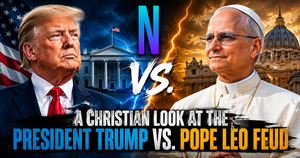
Two of the most influential men in the world are President Donald Trump and Pope Leo XIV. However, the two men seem to agree on very little. What should Christians think about the ongoing "feud" between the two?
Donald Trump is no stranger to calling out those with whom he disagrees. The president routinely takes to social media (or the actual media) to deliver messages publicly to those who oppose him. Some of these disputes are one-sided, with Trump airing his grievance without response, while others become all-out feuds.
The 45th/47th President of the United States has had public political back-and-forth with individuals like former supporter and Congresswoman Marjorie Taylor Greene, ABC late-night talk show host Jimmy Kimmel, and former The View co-host Rosie O'Donnell.
One of the most interesting of these public disputes, though, has been his feud with Pope Leo XIV.
The leader of the Catholic Church, though more conservative than his most recent predecessor, has been an outspoken critic of Trump, especially as it pertains to certain political policies. Plus, as the first American-born pope, Leo's criticisms hold more weight than those from his predecessor, Pope Francis.
While the delivery of their messages has not always contained equal levels of decorum, the two have traded public barbs for the past several months.
But what should Christians think about the high-profile public feud? This article will seek to examine the President vs. Pope argument by taking a look at its history, its reception by conservative and liberal politicians in America, and what the Bible says that can relate to the discussion.
Facts and observations about the dispute between President Trump and Pope Leo, plus a look at their public disagreements
- Pope Leo has criticized Trump's policies on several issues (immigration, the Venezuela situation, and climate change, among other things), but some of the loudest public criticism has centered around the ongoing war against Iran.
- When discussing immigration, Leo has loudly called for protest against the United States' crackdown on illegal immigration and deportation, arguing that the Trump administration has acted "inhumanely" and may not be as pro-life as they claim. While there have been some instances in which these critiques may hold up, these claims are largely exaggerated and uncharitable.
- Trump has not offered much public response to the pope's criticism of his immigration policies, instead usually opting to ignore him altogether.
- Leo said that he had "great concern" regarding the way the United States handled the removal of Venezuelan dictator Nicolas Maduro, particularly the use of "diplomacy based on force."
- Perhaps as a combined response to the pope's criticisms, Trump called him "weak on crime" and said that adhering to his positions would require a leader to be "endangering a lot of Catholics and a lot of people."
- A large chapter in the story of the Trump-Leo discourse on the current war in the Middle East came on Easter Sunday and the ensuing days. President Trump threatened additional attacks on Iran before escalating the threats to include ridiculous hyperbolic language, like "A whole civilization will die tonight."
- Pope Leo XIV responded, correctly calling the threats "unacceptable," but he went so far as to imply that Trump was becoming an international criminal who was leading the United States away from the morality needed for the "good of the people."
- Leo's thoughts on the war continued, as he later said that God's people can "never [be] on the side of those who once wielded the sword and today drop bombs." He said about President Trump that the "delusion of omnipotence that surrounds us and is becoming increasingly unpredictable and aggressive," adding that he believed the president was acting in the "idolatry of self and money."
- Earlier this year, Trump also posted an AI-generated image of himself that drew widespread criticism, including from the pope. In the image, Trump appeared to be playing the role of Jesus healing a man, something that he said was his intention to do for the nation; however, many viewed the image as blasphemous.
- Both Trump and Vice President JD Vance have cautioned the pope that they believe he should stay out of political matters. Trump even said that he is "not a fan" of Leo and doesn't think a pope should criticize a president.
- Secretary of State Marco Rubio, a practicing Catholic, recently traveled to the Vatican to meet with Pope Leo in an attempt to calm the tension between the pope and the president.
What the Left says about the dispute between President Trump and Pope Leo
As one would expect, most American Democrats have been critical of President Trump's recent interactions with Pope Leo XIV, though the reasons behind the criticism vary within the party.
- Former Vice President Kamala Harris said that she believed Trump was guilty of "war crimes" in Iran and that his comments directed toward the pope (and any other critics) are "abhorrent."
- New York Senator Chuck Schumer argued that "Donald Trump reached a new low when he insulted Pope Leo." He also criticized the Trump-branded edition of the Bible that he sells and said that it was ironic that the commander in chief was arguing with someone considered "holy" by many who voted for him.
- Texas Representative Greg Casar said, "Somebody take the president’s phone away from him," in response to Trump's social media responses to Pope Leo.
- Former Massachusetts Representative Joe Kennedy III (yes, a member of the Kennedy family that has been in American politics for decades and a relative of Secretary of Health and Human Services Robert Kennedy Jr.) called Trump's behavior "appalling" and "blasphemous, deranged, and a total desecration of Christ’s message," calling for "Catholics and all people of faith" to express their displeasure.
- California Representative Mark Takano displayed some of Trump's comments during a congressional hearing as a means of drawing attention to his social media/online antics, highlighting the idea that if the comments are inappropriate for Congress, they should be inappropriate for the president to make.
- In a broader sense, many liberal politicians have contended that Trump's issues with Pope Leo stem from his desire to stoke the flames of war in the Middle East.
What the Right says about the dispute between President Trump and Pope Leo
Sentiments on the right side of the political aisle in America are somewhat mixed regarding the Trump-Leo tiff. Some support the president blindly, some oppose him fully, while most sit somewhere between those two extremes.
- As expected, Vice President JD Vance sided with the president, saying that he disagreed with the pope's idea of what is or is not a "just war." He also added that he feels like Pope Leo should "be careful" when speaking about theology to avoid an intersection with politics.
- Secretary of State Marco Rubio played the middle. Despite being the president's chosen diplomat to speak with the pope, Rubio declined to comment on his conversations with either party. Instead, he said that President Trump "acts in the best interest of the United States," regardless of anyone else's opinions.
- Louisiana Senator John Kennedy broke party ranks with his criticism, saying that he felt Trump was waging a "holy war" against the pope and that he was creating an unnecessary distraction. Reiterating his political allegiance with the president, Kennedy said, "I love the president like a taco," but "I don’t agree with him about this new holy war with the pope." Kennedy is a Protestant but says he supports Catholicism.
- Pennsylvania Representative Brian Fitzpatrick called Trump's remarks "sacrilegious."
- US Ambassador to the Holy See (Vatican City) Brian Burch downplayed the idea that there is a rift between Trump and Leo or that there is one between the United States and the Vatican. Instead, he claimed that the president and the pope have just exercised their rights to have "open dialogue."
- Though not American, Italian Prime Minister Giorgia Meloni, a conservative in the Italian government, has called Trump's comments on the pope "unacceptable."
What the Bible says
The back-and-forth argument between President Donald Trump and Pope Leo XIV is not one that looks particularly good from a worldly perspective. However, there are plenty of things for Christians to consider biblically when developing their opinions on this matter.
First, and most important, neither modern Catholicism nor Trump is Christian.
Though this is far from the end of this discussion, it should be noted that modern Catholicism (and its leader, Pope Leo XIV) is not Christian. Neither is Donald Trump.
Many consider the Catholic Church to be part of the Christian faith. However, Catholicism fell further and further away from biblical fidelity over the centuries after the Early Church, eventually leading to the Reformation and the formation of Protestant denominations. In the generations that followed, faithful believers became Protestants.
The biggest disagreements between Protestantism and Catholicism—and what separates the Catholic Church from God today—can be seen below:
- The Catholic belief of justification via faith and works (as opposed to sola fide/by faith alone and sola gratia/by grace alone; Ephesians 2:1-10, Galatians 2:16)
- The Catholic Church's doctrine of impartation (as opposed to imputation; Genesis 15:6, Galatians 3:6) in which they argue Christ's work literally gives His perfection and righteousness to believers instead of crediting believers with His righteousness; relatedly, Catholics also erroneously say that the Son of God's literal body and blood are transubstantiated into the Communion/Lord's Supper/"Eucharist" elements
- Catholics' practical combining of justification and sanctification into one doctrine (as opposed to justification being a "moment" in which Christ saves an individual and sanctification being a life-long journey in which Jesus makes His followers more and more like Himself until eventual glorification in Heaven; 1 Corinthians 6:11, Romans 8:30)
- The Catholic embrace of idolatry and additional pseudo-worship of Mary and "saints" as mediators between God and mankind (as opposed to the First Commandment's requirement to only worship God and the Second Commandment's law against idolatry and as opposed to Jesus' role as the only true mediator as the perfect High Priest; Exodus 20:3-6, Hebrews 4:14-16)
- Catholicism's elevation of one man/office in the pope (as opposed to pastors/elders being teachers and shepherds who humble themselves in service of the Lord; 1 Peter 5:1-6)
- The Catholic Church's continued use of indulgences as penance for sin (as opposed to the biblical doctrines of forgiveness and repentance; Mark 2:7, Luke 5:21).
Based on the verses listed above, it is easy to see where Catholics get these doctrines wrong.
As for Trump, his lack of Christian faith is in accordance with his own testimony, both verbal and active. Though the president has made numerous positive statements about Christianity and his belief that the United States would be a better nation if it experienced revival, he has said and done several things that indicate that he does not have a relationship with Christ:
-First, and most telling, for much of his time in the spotlight, Trump denied being a Christian. He said outright in a 1990 interview that he "doesn't believe" in Heaven or Hell, and that is not the only example of him making similar comments. Obviously, significant time has passed since then, but his more recent comments aren't great, either. Trump told Fox News' Peter Doocy, "I don’t think there’s anything going to get me in Heaven. I think I’m not maybe heaven-bound...I’m not sure I’m going to be able to make heaven." He has a flawed understanding of salvation, thinking it comes on the basis of one's morality, but he also acknowledges that he is a sinner without acknowledging that he needs a savior. When asked if he had ever asked the Lord to forgive him for his sins, Trump said, "I am not sure I have. I just go on and try to do a better job from there. I don’t think so...I don’t bring God into that picture. I don’t."
-Similarly, Trump's behavior is not indicative of one who has been redeemed from sin and seeks to walk in step with the Spirit (Romans 8:1-11). As mentioned earlier in this piece, works do not save; only faith in the work of Jesus Christ can do that. Ephesians 2:8-9 says, "For by grace you have been saved through faith. And this is not your own doing; it is the gift of God, not a result of works, so that no one may boast.") However, according to Scripture, Christians are identified by their good works. Jesus says in Matthew 7:17-18, "So, every healthy tree bears good fruit, but the diseased tree bears bad fruit. A healthy tree cannot bear bad fruit, nor can a diseased tree bear good fruit." and James 2:14, 17 says, "What good is it, my brothers, if someone says he has faith but does not have works? Can that faith save him?...So also faith by itself, if it does not have works, is dead."
In the face of opposition, Christians are called to love, forgive, and turn the other cheek, not take shots at one another from afar.
Frankly, the interactions between Trump and Leo showcase some unfortunate truths about modern society.
For the pope, much of his role in this controversy has been one of passive aggression. Many of his words of opposition against President Trump have been very obviously directed toward him, just without the directness that honesty and integrity would require. This type of behavior has become increasingly common, especially in the era of social media; uncoincidentally, several chapters of this dispute have come via social media platforms.
The president has been a public relations director's worst nightmare on many occasions, but this has been one of the top examples of that reality. However, his missteps here go beyond social foibles; he has publicly sinned. In addition to the obvious ways (his ungodly actions and words are well-known), Trump wields his power and influence over others as a weapon. Verses such as Ephesians 6:9, and Philippians 1:28 instruct believers not to threaten or intimidate and remind believers never to be swayed by those who try to do those things.
Both men, in these ways and likely in others, have wronged the other. Instead of taking the Christ-like approach (lovingly forgiving and turning the other cheek), they have repeatedly responded to each other, whether directly or indirectly. Taking veiled (or unveiled) shots at another person is typically not going to be very God-honoring.
From a practical standpoint, both Trump and Leo make some solid points, but neither gets it all right.
Both President Trump and Pope Leo have made some good arguments regarding their political stances, and both men's viewpoints can find some merit in Scripture. However, neither has a worldview that perfectly adheres to what God teaches in His Word.
Where Pope Leo is correct in his preference of non-violent diplomacy, he takes his passivist ways too far; when he says that Christians can never support one who "wield[s] the sword," he neglects to remember that God gives authority to governments to wield the sword when necessary. Whether or not the United States government should wield the sword in the current conflict in Iran can surely be debated, but the pope's stance that Christians can never support a war is misguided and ignores the fact that the Lord commanded His people to fight throughout Scripture.
Where Trump is correct in pointing out that Pope Leo's positions are likely "weak on crime," his public ridiculing of the man is not needed. The rhetoric surrounding his threats against Iran and other Middle Eastern nations go well above and beyond what is acceptable, something that the pope has accurately pointed out on numerous occasions.
As has been touched on previously in this article, both President Trump and Pope Leo have exaggerated in making their points. That might not seem like a big issue to some, but it is a violation of the Ninth Commandment: "You shall not bear false witness against your neighbor" (Exodus 20:16).
Final verdict
Neither President Trump nor Pope Leo XIV emerges from their public arguments looking great.
While Leo holds to several admirable positions, some of his takes lack real depth in the face of nuance, and he loses a certain amount of faith-based credibility with his passive-aggressive form of "confronting" the president. In the instances in which he has more directly addressed Trump, he has made some overly harsh accusations, as well.
Trump escalated much of the disagreement between himself and the pope, and his use of social media is (and has been) problematic. He holds strong to his belief that a corrupt foreign enemy should not have nuclear weapons, which is a good thing, but he does not handle his messaging well, and his intentions are sometimes questionable.
Neither man is a Christian, though they both have professed to be at certain times, and that is an important aspect of this discussion. Their interactions warrant criticism, both morally and on the grounds that Christians are called to behave "in a manner worthy of the calling to which you have been called" (Ephesians 4:1). Because they both claim faith in Christ, they should be held to the standard of acting like it.
The good news for both Trump and Leo, and the good news for all of mankind, is that there is, well, Good News.
The Son of God came to Earth because we, as sinners, could never reach Him on our own. He lived a perfect, sinless life before willingly giving Himself up to die on a cross, dying a death He did not deserve, in place of those who did deserve it. After paying the debt that mankind owed for sin, He rose from the grave, forever defeating sin, death, and Hell for those who place their faith in Him.
Christ's work overcomes the sin of those who give their lives to Him, even sins such as exagerrative lying, passivity, or making threats.
For the non-believer, this presents an opportunity to find the only redemption that lasts beyond this life.
For the believer, this presents an opportunity to pray for both the president's and the pope's repentance and to pray for all who may be led further from the Lord by their influence.